

ATX Writing Club | Featured Writer

Ethan Brooks
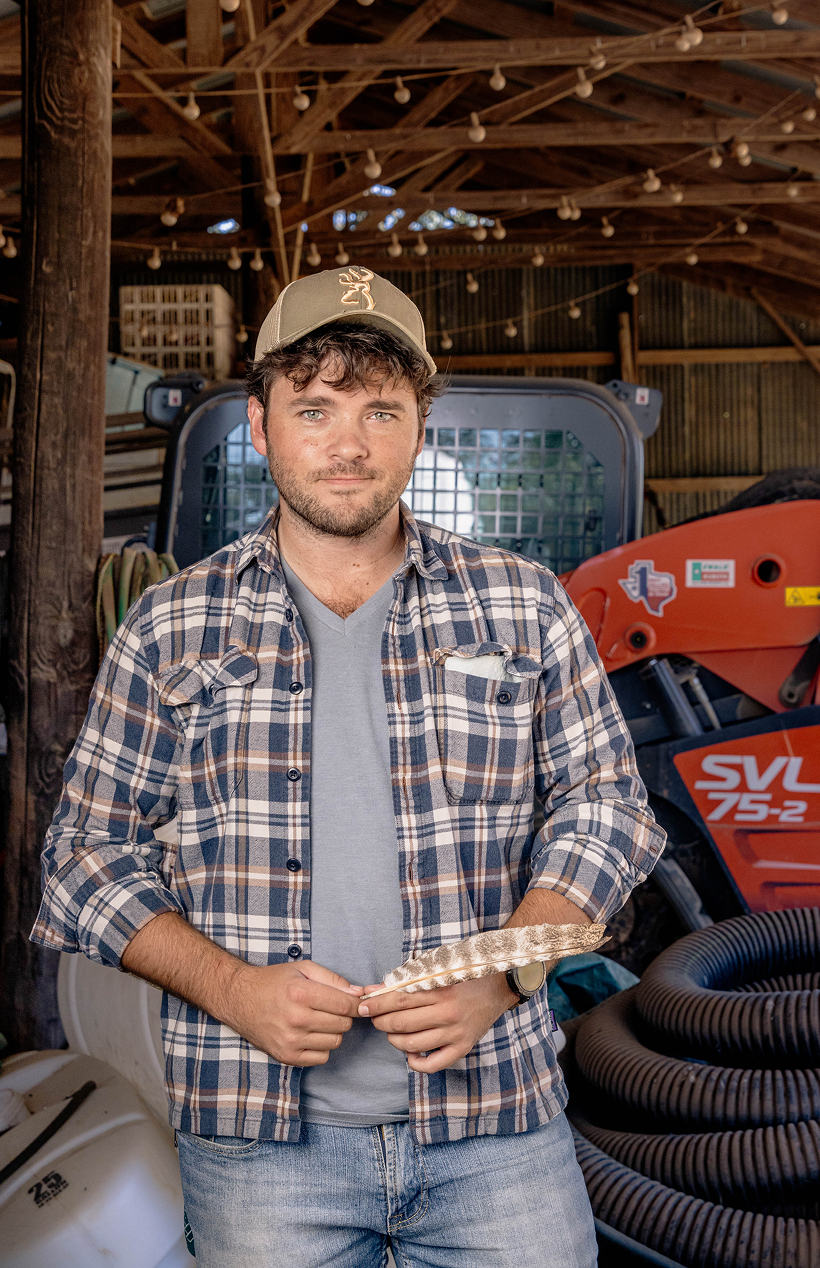
The knee-high farmstand at the end of Pfeiffer Road can sell you all sorts of natural wonders, for a price.
Beautyberry juice, hand-picked in the fields, blended at home, strained, chilled, and mixed with a little monk fruit extract for taste – five dollars. A pack of golden lead ball seeds – seven dollars. Turkey feathers found around the farm – five dollars a piece. Buy two, get the third free.
If you are a shrewd negotiator, the owners may throw in a sticker, or a box of toothpicks to sweeten the deal. But generally, they will take you for all the cash you have.
Partly because, at just four and eight years old, they’re cute, and they use this advantage to devastating effect against anyone who does business with them. And partly because two of them are the children of very successful entrepreneurs, and they’re learning the family trade fast.
Katie Forrest and Taylor Collins are the parents in question. Multi-time founders of multimillion-dollar food brands including EPIC Provisions and Force of Nature meats. They own this land, and are responsible for the hundreds of thousands of souls that dwell upon it any given day – songbirds mostly, but also chickens, ducks, turkeys, geese, bees, pigs, and a herd of bison.
There were a few dozen extra souls on the day we went. Visitors from the city who had paid to take part in a special event. A bison field harvest – the first of the fall – in which a member of the herd would be killed for meat, and the ranchers along with local butchers and chefs would show how that’s done.
We got there early, parked in the grass, and walked up the dirt road that led to the field house, where people were waiting for things to start.
The knee-high farmstand was stocked but vacant, its owners running around playing as the adults prepared for the day ahead.
Here and there ranch hands talked with chefs as they all moved things from one truck to another. Under the big oak trees that dominated the space, tables had been laid out for the work. And everywhere, there was the anticipation that comes before something good, but difficult.
Off in the fields, beneath another stand of oaks, the bison stood together in the dappled shade.
We didn’t know much about what to expect. The website had been surprisingly sparse, promising only that we would participate in some unspecified way, and that the event would probably change our lives.
Taylor gathered everyone in a sunny part of the road that snaked between the field house, the sprawling oak trees, and the big tool shed, and prepared us for what was to come.
He told us how the animal had lived its entire life on this ranch. How in doing that, it had helped the ecosystem, its hooves tilling the land while its manure spread the seeds from one place to the next, transforming the grass into vital nutrients to be worked back to the soil.
Now, it faced its final transformation into something that would sustain us, he said. And he made a point of saying that it would go quick, surrounded by family, with its favorite food in its mouth – a sudden expansion of consciousness and energy.
Then, Katie spoke, and as she did, she looked past us out to the field where the herd was grazing.
He was the last of his litter, she told us, and it had been a hard year, the year he was born. They’d had one-hundred percent pregnancy rates – a sign of health among the dozens of cows. But there were complications, and losses, and only seven calves hit the dirt.
It ended up being a blessing. Drought conditions would have made it hard to support more.
But as she spoke, she stared out to that field, and her voice caught, and tears came, and that’s when the weight of it finally hit me.
This wasn’t just a family business. It was family business. And they were letting the world in on something personal.
Years before there was ROAM Ranch, or EPIC Provisions, there was Thunderbird Energetica, a vegan energy bar brand that Katie and Taylor co-founded in 2011.
Longtime endurance athletes, they’d fallen in love with each other over hundred-mile Iron Man training rides, and were always searching for the best ways to fuel performance.
While struggling with severe and mysterious knee problems that often left her immobile, Katie started removing foods like refined sugar from her diet and experimented with ingredients like turmeric, and cinnamon.
In doing so, she developed some of the early recipes for Thunderbird bars, and together, she and Taylor went from vegetarian, to vegan, to raw vegan, and eventually, juicing, all in search of better health and performance.
The company did well, landing an early deal with Whole Foods, and expanding nationally, such that by 2013, they were in 47 states and shipping four-thousand bars a day.
But Katie’s health problems continued, and doctors were stumped.
One told her she needed to be on arthritis medication the rest of her life. Another recommended a full knee replacement – both devastating prognoses for an athlete still in her mid-twenties.
Then one suggested reintroducing high-quality meats back into their diet.
They did, starting with a grass-fed steak, and within weeks, years worth of symptoms disappeared entirely.
So for them, grass-fed meat wasn’t just a livelihood. It had literally given them their lives back.
Within months, they announced the launch of their Epic line of meat-based snack bars, and by 2014, they’d spun it out as its own company, selling Thunderbird to their first investor, and going all in on the brand that would change their lives forever.
We headed for the trucks and trailers that would take us to the field.
Jesse, the ranch manager, settled into a four-wheel gator in the lead. He’d be the one taking the shot when the time came, and a few people who’d paid for a more intimate experience climbed in with him to be there when it happened.
Others loaded into a long, low trailer with a wood plank floor, a mesh sunroof, and benches up both sides.
When the trailer was full, the last of us piled into the bed of the pickup towing it, riding with the gaggle of robber barons from the knee-high farmstand.
The two older girls were excited, and looked out over the field as we drove.
They laughed, and squirmed, and told us about the recipe for the beautyberry juice they were selling, and about the buy-two-get-one deal they had on feathers.
The youngest was nervous for the shot. She had her hands over her ears before we’d even started rolling, and the other girls were reassuring her, telling her there would be plenty of warning before it happened.
The caravan pulled through the gate of the bison pasture and, hugging the fence, crept up the edge of the field and out into an open spot perhaps eighty yards from where the bull stood beneath the oaks.
We watched as Jesse rode in closer, using the gator like a pony to drive the herd this way and that, working that day’s bison to a place where he could be taken safely.
The gator rode low through the animals, who clustered so thick that we could barely see the rig from where we sat at the edge of the field.
Everyone fell to a hush, and the engine of the pickup switched off so that the only sound was the putter of the gator’s motor as it worked the angles of the herd, and the soft, steady rustle of the bison as they moved to get out of its way.
From the beginning, the bison was the hero-animal of EPIC Provisions, and their best-selling bar.
So much so, that within three months of scaled production, they had exhausted the country’s entire supply of grass-fed animals.
There are only about five-hundred thousand bison living in the US today. Of those, most are fed grain and confined at the end of their lives, just like cattle, in an effort to maximize yields, control costs, and get some uniformity of flavor for consumers.
To make the product they wanted, Katie and Taylor realized they were going to have to change entire supply chains.
So they brought on longtime friend and fellow Austinite, Robby Sansom, who served as EPIC’s COO/CFO, and helped architect their stratospheric rise.
It takes three years to raise a bison for market, and during that time, ranchers face a lot of uncertainty around pricing. To incentivize more of them to invest in grass-fed operations, Robby and EPIC started signing multi-year contracts, locking in prices years in advance to help de-risk things for producers.
Fueled by their mission, and buoyed by the simultaneous rise of the paleo, keto, and gluten-free movements, the brand exploded, growing to $20m in revenue in 2015, and selling for a rumored $100m to General Mills less than three years after launching.
Rather than cash out, Katie and Taylor rolled the winnings into four-hundred and fifty acres of barren farmland in Fredericksburg – the land upon which we sat now. Decades of industrial farming had left the soil nearly void of life, and they got to work turning it into a laboratory for regenerative agriculture.
There was no hint before the crack of the rifle shot.
The herd was simply moving one moment, still for a heartbeat, and moving again a moment later.
They didn’t bolt or startle. From back in the trailer, it was hard to tell that anything happened, except for the snap of the .30-06, which came softer than I was used to – perhaps washed out as it traveled to us across once bare land, now thick with grasses and wildflowers.
Taylor had told us that the bison had their own way of acknowledging the loss of a member. And though I couldn’t quite see it all from where I sat, I had an idea of what they were doing in those minutes after the shot.
Each member would smell and probably touch the bull who’d been killed, he said – a quiet acknowledgement of its transition into death. The other bulls would rustle him or even stick the carcass despite the fact that he was dead – their way of preserving status, and jockeying to fill whatever space he had left in their ranks.
And the cow that had birthed him, his mother, would be the last one near him when the gator finally came up to drive the herd off.
There was a feeling that I’ve been trying to write ever since the moment when we walked up on him. A flicker of some ancestral memory, from a time when it was more common to gather around the freshly-killed bison under a crystalline sky.
But I can’t capture it, really. And it occurs to me that maybe this is why the website is the way it is.
Some things you just have to experience, because they come from the time before words. And when you do, you shouldn’t try to write about them unless you’re sure you can do it right.
I can tell you bits from before they took him away. Like how his eyes were still open, or how the butcher told us not to say sorry as we bent down to feel his hyde, only thank you.
But mostly, that moment belongs to the people who were there, and particularly, to the family that brought us there to share it.
When enough time had passed, and both the herd and the people had said their goodbyes and their thanks, the skinners took him back to the place beneath the oaks by the field house.
There was a long morning of work left to do, then a long afternoon of cooking before the farm would welcome still more guests to share in the feast.
I used to wonder why they did all this.
When they sold EPIC, they could have retreated to a private beach, and never worked another day in their lives. Instead, they stayed on at the brand, bought this ranch, and co-founded another company – Force of Nature – with their old COO, Sansom.
Now they almost certainly work harder than they did before they were rich.
The only answer I can come up with is that they actually mean it when they talk about the mission of these companies.
Look, I’m a business writer. I hear a lot of bullshit mission statements.
But I can count on one hand the number of deca-millionaires I’ve seen who are actually shoveling bull shit (and pig shit, and duck shit, etc.) in pursuit of those.
The mission of EPIC was to change food systems. To grow awareness and demand for high-quality meats, then parlay that into better incentives on the production side.
To that end, General Mills became the first major company in 2019 to sign a regenerative pledge, vowing to help support the creation of one million acres of regenerative farmland by 2030.
ROAM has a role to play in that – experimenting with regenerative techniques, and sharing the lessons onward.
And then there’s Force of Nature, another food company focused on change.
They aggregate meat from regenerative farms like this one, and sell it all under one label, offering smaller producers the kind of scale needed to get on the shelves at bigger retailers, so that customers can start voting on the regenerative issue with their dollar.
Whole Food, Natural Grocers, H-E-B, and more – you can find them in more than four thousand retailers across the country today.
Or, you can get it next time you visit the ranch. Katie will sell it to you from a cooler she wheels out from the ice house, stocked with grass-fed ribeyes, New York strips, and more.
Fret not if the tycoons of the knee-high farmstand have already taken all your cash – you’re still in luck. Because their mother accepts credit cards.